Free Ductwork Estimate Template
For duct installation, replacement and modification jobs: runs by the linear foot, registers and panels by the piece, labor in blocks, and a margin check.
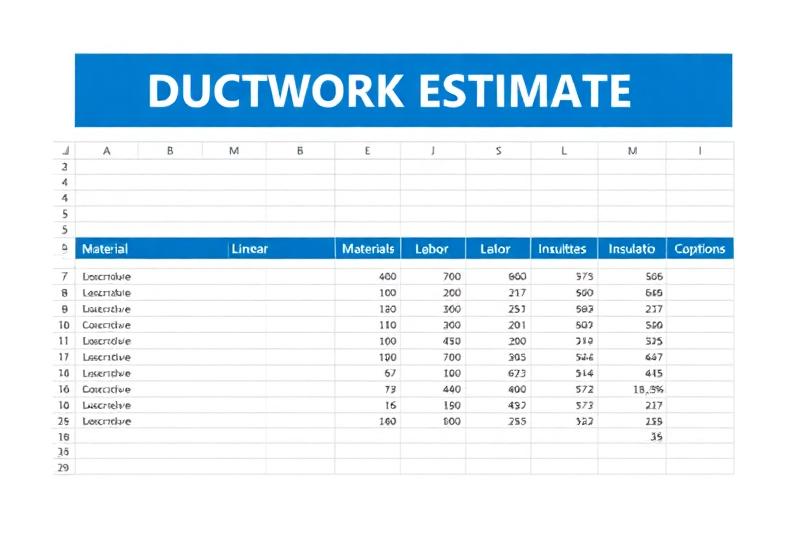
A Ductwork Estimate Template Priced by the Foot and by the Piece
Ductwork doesn't price like equipment. Most of the money is in lengths of trunk and branch, the registers and grilles at the ends, insulation and sealing, and the hours it takes to tear out, fabricate and hang it all. This template is laid out that way: linear-foot lines for the runs, per-piece lines for registers, grilles and access panels, job-priced lines for mastic and hangers, and three labor blocks for demo, fabrication and sealing.
It suits a full replacement, a new system in an addition, or a modification like rerouting a trunk. The job block records the project type and the insulation R-value so both appear on the customer copy.
Free, and it downloads straight away, no email needed. For the design side of a duct job, read HVAC ductwork estimation and CFM calculations before you start entering lengths.
What's in the Ductwork Estimate Template
Four tabs: amber cells take your input, white cells are protected formulas.
Start Here
How to work through the file in five steps and what the cell colors mean.
Settings
Your company block, $125 billable and $87 cost per hour to start, 7% sales tax, markups by category (all the starter duct lines use Materials at 35%), 50% deposit, 30-day validity and a one-year labor warranty.
Estimate
Nine starter lines: main trunk (40 linear ft), branch ducts (120 ft), flex duct (60 ft), ten supply registers, two return grilles, R-8 duct insulation (200 ft), duct sealing and mastic, two access panels, and hangers and supports. Labor blocks: demo and removal (4 hours), fabricate and hang duct (12), seal, insulate and balance (4). Room for 18 items and six labor lines.
Customer Copy
Customer and job details with project type and R-value, each line with quantity, unit, unit price and total, labor hours, totals with deposit and balance, terms including the local-code and R-value line, and a signature line.
How to Fill In the Ductwork Estimate
- 1
Set your rate and markup
Ductwork lives or dies on labor, so put your real billable rate and true labor cost on Settings. Check the Materials markup too, since every duct line uses it.
- 2
Measure the runs
Take off linear feet for the trunk, each branch size and any flex. Size them first with the duct size calculator. Add a line per duct size if your costs per foot differ.
- 3
Count the pieces
Supply registers, return grilles, access panels, boots and fittings go in as each. Fold small fittings into the per-foot cost or list them; just be consistent.
- 4
Add insulation and sealing
Insulation is entered by the linear foot at your R-value. Mastic, tape and hangers are job lines at a single cost.
- 5
Enter the labor blocks
Hours for demo and removal, fabricate and hang, and seal, insulate and balance. Attics and crawlspaces deserve more hours than an open basement.
- 6
Check the margin
The margin check counts your labor at your cost per hour, so on a labor-heavy duct job it shows quickly whether your rate is high enough.
- 7
Send the Customer Copy
Record the project type and R-value, then save the Customer Copy as a PDF.
Worked Example: A Duct Replacement
Example only. The starter lines in the file, every one in Materials at the default 35%, with $125 an hour billable, $87 cost and 7% tax.
Margin check: $3,465 of materials plus 20 hours at $87 ($1,740) is $5,205 of cost. Gross profit is $1,972.75 on a $7,177.75 price before tax, a 27.5% margin (27% on the sheet), under the 30% floor the sheet warns about.
The fix on a duct job is usually the rate, not the materials. At 50% on materials and $150 an hour, the same job is 36.5%. The HVAC labor rate calculator shows what your hour has to cost to cover overhead.
Ductwork Estimate Template FAQ
Does the ductwork estimate template calculate duct sizes or CFM?
No. It prices the job once you know what you're installing. Size the trunk and branches first (the duct size and CFM calculators help), then enter the lengths and fittings as line items.
How do I price duct by the linear foot?
Set the unit to linear ft, enter the run length as the quantity and your cost per foot as the unit cost. The template adds your Materials markup to the cost to get a price per foot, then multiplies by the length for the line total.
Where do fittings like elbows, boots and takeoffs go?
Either fold them into the per-foot cost of each run, or add them as their own lines with the unit set to each. Separate lines take longer but show you exactly what the fittings add, which matters on a job with a lot of short branches.
Why is labor such a big share of a ductwork estimate?
Duct jobs are mostly time: tearing out old duct, fabricating and hanging new runs, then sealing, insulating and balancing. In the sample job labor is a third of the price before tax, so your hourly rate matters more here than on an equipment swap.
What do the project type and insulation fields do?
They are text fields in the job block for new, replacement or modification work and the insulation R-value. Both print on the Customer Copy, and the terms add a line that all ductwork meets local code with insulation R-value per specification.
Related Guides and Calculators
Rather Do This in an App?
EstimateKit does this in an app, $49 a month for the whole crew, 14-day free trial, no card.
Start Free Trial